Sunday, December 9, 2007

Still a Long Walk for the Farmers. . .


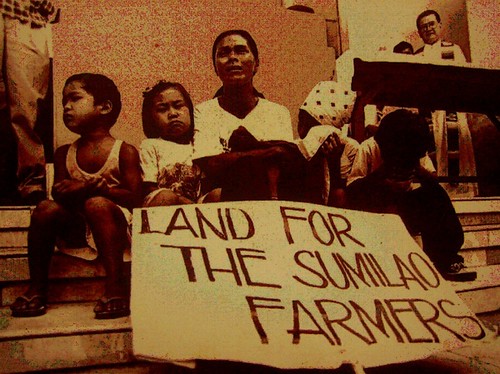
After convening in Baguio, summer of 1997, the Second Division of the Supreme Court finally decided on the controversy brought before it regarding the validity of the “Win-win resolution” which originated from the Office of the President through Deputy Executive Secretary Renato Corona (settling the issues posed by the biased decision of Executive Secretary Ruben Torres) by allowing the farmer-beneficiaries of Sumilao, Bukidnon a share of the 144-hectare land allegedly owned by Norberto Quisumbing. In that win-win resolution, the Office of the President ordered the distribution of the 100 hectares to the farmer-beneficiaries and the remaining 44 hectares to be devoted to the conversion plan proposed by Quisumbing and approved by Torres.

After a long and arduous wait, the Sumilao farmers who have long been fighting over the ownership of their ancestral land finally had the attention of the nation after taking their pleas before the streets of Manila. On October 9, 1996, these farmers staged a hunger strike in front of the DAR office, supposedly in charged of implementing the CARP which is supposedly aimed at redistributing the vast lands of hacienderos to tenant-farmers. That hunger strike was devastating to the government as it was boasting the fruits of economic growth back then. Thus, it intervened, albeit harshly against the farmers, at first, when it issued an order approving the conversion plan applied for by Quisumbing which covered the entire area of 144-hectares. It modified subsequently its own order upon pressures from the church and civic groups. Corona issued the so-called win-win resolution granting the 100 hectares to the farmers and the 44 hectares to Quisumbing. . .a little too late.

A little too late because back in the province of Bukidnon, the local government units have been in haste adopting the first order issued by Torres; a bitter betrayal for their own constituents.

And as if to validate the fact that justice does not come easily for the underprivileged, the Second Division held that the first order issued by the Office of the President is already final and executory, thus, could no longer be assailed. To quote the ponente, Justice Martinez:

Now to the main issue of whether the final and executory Decision dated March 29, 1996 (Torres’) can still be substantially modified by the "Win-Win" Resolution.

We rule in the negative.

The rules and regulations governing appeals to the Office of the President of the Philippines are embodied in Administrative Order No. 18. Section 7 thereof provides:

Sec. 7. Decisions/resolutions/orders of the Office of the President shall, except as otherwise provided for by special laws, become final after the lapse of fifteen (15) days from receipt of a copy thereof by the parties, unless a motion for reconsideration thereof is filed within such period.

Only one motion for reconsideration by any one party shall be allowed and entertained, save in exceptionally meritorious cases. (Emphasis ours).

The Supreme Court ruled out based on technicalities. But in the same ruling, the Second Division apparently misquoted how equity is weighed in controversies affecting the marginalized sectors of society.

Be it remembered that rules of procedure are but mere tools designed to facilitate the attainment of justice. Their strict and rigid application, which would result in technicalities that tend to frustrate rather than promote substantial justice, must always be avoided. Time and again, this Court has suspended its own rules and excepted a particular case from their operation whenever the higher interests of justice so require.

As if to castigate further the petitioners on the misavoidance of the rules , the Supreme Court added:

In the instant petition, we forego a lengthy disquisition of the proper procedure that should have been taken by the parties involved and proceed directly to the merits of the case.

Supreme of all, the Supreme Court erased any silver lining that should supposedly be gleaned upon from this sad plight of the farmers. It ruled no less that the MAPALAD farmers are not real parties-in-interest. In its own words:

The rule in this jurisdiction is that a real party in interest is a party who would be benefited or injured by the judgment or is the party entitled to the avails of the suit. Real interest means a present substantial Undoubtedly, movants' interest over the land in question is a mere expectancy. Ergo, they are not real parties in interest. interest, as distinguished from a mere expectancy or a future, contingent, subordinate or consequential interest.

And so Norberto Quisumbing really had his day in court without even stepping into the hall of justice. The petitioners were peculiarly the local government units of Bukidnon and the Corporation owned by Quisumbing. The defendants were Corona and the DAR defending the validity of the win-win resolution the former issued. The MAPALAD farmers filed a motion to intervene, but the Supreme Court denied the same. Few years after, the conversion plan approved by Torres did not materialize instead Quisumbing conveyed the questioned land to the SMFI. SMFI is now claiming ownership over the land and is now developing it into an agro-industrial estate divesting further the claims of the farmers. And so the long and arduous walk. . . Protesting to suffer or to suffer in protest?

The long walk by the Sumilao farmers from their lands to Malacanang to press the government to order SMFI to return their lands which were subject to CLOAs previously could never be a shooting for the moon even at this stage where legal ownership has already been vested to SMFI. It is a continuing struggle that transcends any legality constituted improperly and based on wrong and malicious political favors. However, it is very distressing that the suffering of the farmers for relentlessly invoking a right has gone this far. The long walk is pregnant with symbolism. It no less than confirms that the government was too far for the South. It was unable to reach out for centuries even at this point of time. Not even a Senator who’s born from Mindanao could disprove the fact that services are too controlled to trickle down south. Really, if the Honorable Senator has the balls to mediate and reach out to the farmers, at the least to assuage them because of their torn lives right there at their homeland, he won’t be waiting for that photo-ops outside the Senate: he, extending his right hand to one of the protesters who was squatted there under the blistering heat of the sun. Disgusting!

I still have the faith that the struggle of the farmers would end with the farmers reclaiming the lands taken from them. But I’m sure there’s still a long walk to take with the current administration’s disregard for even the most basic of human rights. There’s this news, for instance, which reported that the government would finally intervene before the Left gets into the picture. Imagine!

Tuesday, November 27, 2007

There was an Earthquake Here!

There was an earthquake here past noon. It registered a 6 on the Richter scale, reports say. It registered a 9 based on the Trauma scale, if there is any, among the people causing a little like hubbub over this mountain city. Sirens deafened all ears as paramedics rounded the business district moments after. At a nearby university, hordes of students came rushing in exits leading to a busy road causing severe traffic downtown. The mayor ordered classes and public offices suspended this afternoon in anticipation of aftershocks. In our office, the manager who was casually chatting with us about development issues was shocked by the sudden and prolonged tremor (about a minute, I think). The rest of the people at the building were seen heading for the front door at the instance of the manager; defying panic with the slow and calm pace. We stood by the front door with all the cloud of doubt around our heads if it’s the safest place to be with all the rootless and decomposing tall pine tress and electric posts before us. Nonetheless, the epic ends there as the tri-colored building cat prowled over downstairs toward our direction in that quotidian comportment. What would you expect from such aristocat lounging over after feasting from the leftover menu of a fine-dining resto right next to our building? A blessed cat indeed.

So life for this day went on but, of course, not without shoo-in roundabouts that slowly surfaced memories of a tragedy more than a decade ago. One shared something like her friend who happened to be pregnant at that time feared that her baby would be like a rotten egg. Another shared about trapped survivors eating their excrements for food and urine for water. Those were the last survivors of a ruined hotel who managed to hang on with their lives for weeks until rescuers found them deep in the rubble. Still, another shared how antipathy works among Filipinos even in times of catastrophes as when foreign relief like quality sleeping mats and tents are malversed and transformed into local banigs and mosquito nets instead. More than a thousand were killed in this city alone on that fateful day, July 16, 1990. That tragedy is being commemorated ever since. There’s this policy (or is it a moratorium only?) for instance prohibiting the construction of tall buildings more than two stories high which, however, never came into play as evidenced by high-rise structures sprawled all over the business district. In my school, for example, a 10-storey building was recently completed without any opposition. As it comes, the monuments of development (or mere urbanization) are like mushrooms ubiquitously springing up even in most peculiar scenarios like a mall in a forested hill or a flyover in an open and traffic-less junction road; very surreal phenomena indeed.

On a more personal level, I remember Murakami’s stories in After the Quake; on how the earthquake in Kobe became a subtlety to the different wrought directions mustered by the lives of different lonely and pervert individuals; on how such a devastating quake proved to be less than devastating compared to a person losing his sanity with a mammoth worm and a super frog in mind and another Komura who’s too engrossed with live TV footages on the shattered Kobe unnoticing the abandonment meted on him by her not-so-beautiful wife. I remember myself as a grade-school student being prodded by the teacher outside because of lack of fear and too much interest in solving a math problem on my notes. As we were crouched on the wide open space right next to our classroom where the flag ceremony is being held, I noticed that most of the pupils were looking up in the skies as if waiting for some kind of manna. In our small village, talks about a relative wailing for her daughter who was then billeted at the Hyatt Hotel together with a Japanese became an overbearing news much like a television series where every scene is sumptuously awaited and devoured. The teleserye ended abruptly days after because of a news which mentioned a Japanese sounding name as one of the survivors together with the relative’s daughter. They were apparently enjoying at the Burnham lake when the earthquake hit. In sum, the quake left me nauseated all through out the week with all the shaky experience not to mention the hullabaloos-the most glaring of which was the scene of confessed sinners similarly wailing because of their presumed perdition.

Earthquakes are occurring regularly, so too are ineffable discomforts rooted on tragic memories, and like a seismologist so opined, most of them no longer pass our thresholds of feeling.

Saturday, November 10, 2007

Safest place to be


Two fowls at two opposite and distant directions desperately cluck to announce the coming of dawn. The sound magnifies a mournful of spiel, so traumatic and daunting to bear. They consistently return each other’s clucking as if indulging in an operatic discourse that’s plagued with itinerant swings of joy and sadness. In my mind, they seemed like harbingers of death perpetually lulling the cockles of the heart to sleep and die with truth. The feeling’s like this when you refuse to believe that someone you loved is at the other end of the line, trying to breathe her last and rummaging whatever is left, few minutes after the pumping of life; memories of important events in her life which includes a bittersweet understanding of a lifetime of sacrifice. A sacrifice devoted to a generation ahead but so close to her heart.

I waited for few minutes at the station for the bus to come. Booked for the first trip and ended miscalculating the time, earlier by half an hour. Everyone has their jackets and sweaters except me. This is the early days of January and the cold front still sets low reaching this part of the country. I don’t feel the cold. My body is numb all over. Smoke comes out of my mouth occasionally because of heavy and deep breathing. It is still dark. Few people roam the streets. A number of passengers boarded the bus as soon as it arrived. Never passed a glance at their faces like I used to. For quarter of an hour until I boarded myself my eyes are focused at only one direction, to the skies. The bus left the station at about 4:45.

At 4:45, a distraught man was seated at a lonesome bench. His aura effused a certain feeling, so desolate and unknown. The bus maneuvers towards his direction until it finally sweeps the dust in front of him. He was still all the while; his presence pregnant with undefined emotions.

Grief, they say, is abstract until it crosses your path. Unlike any other emotion, grief is seldom felt in our everyday life until someone close to our heart leaves this physical world. When I was on travel to attend the wake of my grandmother, I witnessed the coming of dawn like never before. As the bus runs along lines of trees, paddies and finally the shores along the gulf, the bulwark of the spill of light gradually swallowed up the dark and venomous abyss on the horizon. The beauty of the coming of the new day has never been this overwhelming yet, for a moment, my heart was unable to respond.

For almost a year after her death, I paid a visit to her grave and brought few dozens of white roses. Shed a tear for the wonderful memories and told her that I will never be the same again; like a stolid marble sculpture of a human figure with broken arms. “I suddenly remember you telling me that you will spook me even in broad daylight if I still don’t get married after you pass away. Go on Nay, won’t bother.”

Friday, October 19, 2007

At the Hangar Market and Beyond


It is but an ordinary day here at Hangar market, October 17, 2007 at about half past twelve noon. The sky above us is grayish and forebodes a rather reluctant downpour amidst a humid air. This is a very busy place like no other. The small stage where the band BINHI will perform is occasionally surrounded by spectators who are mostly laborers: haulers, stevedores, vendors trying to sneek a little of their time to see a different yet familiar milieu in their time. This is where the foils of the earth seethe into growing and unkempt nails; into tonic muscles that reflect woven veins, dead-beat yet sardonically resilient. The smell of air undulates a deferential mixture of smoked fish, aroma of freshly picked and washed vegetables, the stink of the sewers, and the stupor of sweat. This is Hangar market; the heart of trade; trades of all kind. The place of payout for hard-earned work and produce.

The amplifiers worked to stir curiosity among the busy crowd; to attract each and every one in the market that something’s happening at this side, more than minutes of entertainment, this is to celebrate and dignify your labor: the fruit of one’s blood and sweat. Please come, please come. This event is simultaneously conducted nationwide to press the government to live up to its promise and to its covenant in meeting the Millennium Development Goals, one of which is the eradication of poverty in the country. The government pledged to this undertaking more than a decade ago. Four administrations bore witness to many reminders, events like this at Hangar market. It pledged time and again to eradicate poverty through institutional policies and hard-on statements of immediate action. Unfortunately, we’re here again to remind. Years have passed and the goals remained to be goals. Goals that are difficult to realize and achieve. The supposed timeline until the MDGs are reached is from 1990-2015. Previous administrations were able to cut poverty incidence by only single-digit percentages. Half of the population in the country is still living in poverty as of this year. They’re waiting for the Gods.

Why? Because there is no definite and sincere action from the government; only “motherhood” statements and initiatives. The current 10-point agenda of the Arroyo administration to eradicate poverty in the country is but a show-off; a metaphorical set of words perpetually inscribed on a tablet. Policies and programs adjunct to her agenda lacks any clarity and definitiveness. Programs being monitored by the National Anti-Poverty Commission implemented by national agencies breathe the ardor of traditional practices that could never be a rung to the fulfillment of poverty-reduction goals. What the country needs is an aggressive and motivated effort. Not mere mascots like Mang Pandoy and the Bangkang Papel sort that further annihilates hopes for a positive change.

But still, what will you get from a government which settles down at saying: “We have infused P1.5 million for the health care services of geographically isolated and depressed areas; P2.5 million in health care financing in the form of grants and subsidies . . .blah, blah, blah” http://www.napc.gov.ph/govt_poverty_reduction_programs.htm (and more than a billion for the defense? Defense from what?).

And so here we are again. Reports say that this event has drawn more than seven million people all over the country pledging to end poverty. Here at Hangar market, the audience numbered at approximately 200+ individuals: mostly vegetable haulers, vendors, common tao or maggagawa as you may call them. Most of them listening intently to the music of BINHI while someone at a nearby stall plugged his ears with his two hands because of a newfound noise that stirred the latter’s usual life at the market. Another at the side was busy washing the soiled carrots and packing them in a transparent plastic bag. The woman peeking at the window of an old building is staring blankly at the skies. I looked up. The man standing beside me looked up, the others looked up. Our stares pierced the gray skies. After a few moments, BINHI ended the event with their finale song “Lalaya” which narrated the struggles of the Filipino people from the hands of the conquerors to the realms of poverty. BINHI sang the undying hope for freedom and the struggle that must be for its attainment.

As the sounds fade away, the crowd slowly dispersed until what’s left around the space is the small block of wood used as the stage and the inanimate words spoken before it that slowly drifted into the air like a feather dust blown by time. Hangar market was busy. . .busy until the end.

Saturday, September 15, 2007

Quarter of a Century


Nine tall bamboo poles make up the raft that is hitched in one of the mangroves in the bank. It is there stagnant during weekdays. Its life mostly limited upon leveling itself to the tides of the river. It is a forsaken bamboo raft, abandoned by its owner and left to the whims and caprices of whoever will come by and use it. Its existence shrouded by a grasp of communality among the members of our village, fortunately. So that for long years, the raft became a childhood refuge of many who wished to paddle it along the river after a furious whipping by the masters of a house or after a delirious infatuation with a childhood crush.

Mike will later on be the first one to learn how to swim. He frequents the river more than I do. He was my younger brother and more often than not, during those days, he’s the one between the two of us who could discreetly pass by the back of our house [at the prompt of the head of the gang who will signal the boys through a distinct whistle] without being caught by our stern mother; both hands clutching two white plastic water containers for his added floatage in the water. He will run fast as he could towards the road without anyone knowing it till he produces that violent shriek when he’s already on the road to boast of an ephemeral but joyful freedom. There was never an attempt to drag him back home, not even with the presence of nanay, who will just put up a squalid face while muttering to herself: “That wily child.” It’s my brother’s price for pursuing happiness in spite of fear, in spite of consequential punishment. His being quite a liberal will help him later to sire a beautiful child sooner than his older brother. And all I could say afterwards is that: “You seem to be more-good-looking than me.”

I drowned three times in that river; saved only by Badong in that three, sporadic, and failed attempts in trying to swim without the help of two, white water containers. He may never remember it anymore that for a time I consider him as a savior, a life-saver in that morose river. He may never remember it anymore that for a time I have been religiously reminding him that his birthday will come soon and, when privileged to have saved coins and paper bills in that cylinder coin bank, a modest gift on his special day [hehehe]. . . for the gratitude and brotherhood of not divulging such fact for me to continue my swimming endeavor. [or that, unconsciously, you had just let it pass?]

The last incident of drowning happened in a rainy Saturday afternoon. I was crouched on the middle of the raft looking on the splashes of water coming out in between the poles as they jump from it into the river when the raft suddenly overturned together with me. I struggled to stay afloat but I was blocked by the raft above me till my cousin pulled my hair up all the way until my head was above the surface of the water, effortlessly like a tiller does in uprooting onion bulbs. I drank water more than I should need on that day. My belly’s protruding with liters of salt water in it. In spite of it all, I was still able to joke on him: “Your arm seemed to have stretched too long. How did you do that?” The ordeal was quite fruitful for the day after I saw my self doing the dog-swim till I reached the other end of the narrow river.

I am now twenty five. Lived on this world for a quarter of a century already. The atmosphere these days is very, very different decade ago. Not just because of the hard times and physical changes I have gone through but rather because of the knowing feeling that a clock is ticking somewhere even if you persistently and consciously don’t wear a watch on your wrist or don’t hang a clock in your room; and days passing by even if you try to detest the existence of a calendar, its leaves torn down discreetly at the glimpse of an eye. This seemed to be a period for me where I try to measure up relentlessly the things I have done and the choices I have made in those years that contributed to my emotional and spiritual growth. The search now could be likened to a lost pin amidst a fine shrubby ground. The search is even worse if you’re living in a secluded island like me.

One night, in one of my evening classes, Atty. Abiog, a professor in Forensic Medicine lectured on the importance of death to legal matters. Prior to her lecture, however, she gave a lengthy introduction on death in a positive manner to displace the seeming morbidity attached with the subject. An antidote to the succeeding discussions on antemortem lividity, putrefaction, the oozing of lipids, the occurrence of maggots, etcetera, etcetera. Death, according to attorney’s philosophy, is an inevitable circumstance which should be dealt with as it is, as it comes. Death, to her, because of its inevitability, should be taken in the context of day-to-day living. Her talk sounded like an overgrown philosophy much of a passé minus the relenting attitude of neglect because of the I’ve-been-hearing-this-again-and-again kind of distaste. Her voice streamed through like a fresh whisper in a jaded ear that gave a positive reaction felt as far as my strained toes.

My last visit at home was a certain kind of awakening. I had this sentimental walk to our favorite hangout. The river is just a few meters away from our house. You will just pass by three houses, the two-storey house of my aunt, the family home of my cousin Badong, his name appearing on a black, rectangular board that hanged high in the front wall, underneath his name spelled his achievement : certified public accountant, and the house of Apong Konsing, the sister of my beloved lola. Beyond those three structures you will turn left and pass by a small concrete bridge leading to an inner sitio. Few feet away from that bridge is a pasture land and near it is the river bank where we leave all our clothes before we soak ourselves in the water. To my surprise, there’s still a bamboo raft drifting along the bank and I supposed the worn out and dilapidated raft lying there on one side is the one we used to play with? It looked very dry, without life and seemed inutile at its state. I tried to push it to the river and let it drift for one last time.

Saturday, September 1, 2007

Waiting. . .In the Bank Waiting

A brown suede shoe incessantly taps on the white tiled floor, rhythmically, as if carousing in a joyful beat of music. One-two. . .One-two. . .One-two. The sound produced by the tapping wistfully creates a disturbing thought that dances in a sound-proof room devoid of any motion, beat, and understanding. The bank usually gets busy when the week starts, usually a Monday; or after the seceding of spates; tropical storms which interrupt business operations for long days; or after holidays. However, I have never been trapped in a bank for just one transaction for long hours, waiting and waiting and waiting, as if eternally, like a groom torn by the sudden breach of promise to marry by her bride-to-be after the former waited for long hours at the entrance of the cathedral. It’s just like a hopeful waiting. Like a thought of waiting for something, something which has died away long before, some resolutory condition that is not going to happen, or an inevitable circumstance which suddenly become avoidable.

Flashes of faces passing by tired my vision. For once in my whole life, I have never tried to guess the personality of a person by the look of his or her face this much. And as I’ve said, the very judgmental undertaking is tiring. This husky man beats her wife, that old woman is a primadonna, that man who whistles away his irritation is a meek person, that lady crouched on one of the belchers has her semblance with Julie Delpy; her eyes lovely and calm, her lips resembled a mound of a thousand shiny red apples, so polished that they reflected every man’s eyes who looked through them. Her eyes pierced mine, for a split-second I saw her strumming the chords of a guitar, her hand dropping so gently as if caressing and feeling a fragile object (hehehe). Then I asked intently: “Could you sing me a waltz?” Out of nowhere, the voice of a child pounded in my ears like a high-pitched note that almost broke my eardrums. “Ma, could you buy me a toy later!” The mother whispered in the child’s ear: “I will, hon.”

It’s half past twelve. The line’s slowly moving. Teller number 4 and 5 went out of their compartments to have a break. Only two tellers are now accommodating hordes of clients continuously flooding the lobby. Looked at the clock again, its second hand drops heavily, the ticking becomes the beat of the pulse palpitating strenuously because of stress and various forms of agitations. The rancid air aggravates the torment. Suddenly, the walls became sources of comfort.

Framed poster No. 1 taunted the time wasted as if doing a mockery of alienated lives trapped in the four corners of the bank for a day. Sir Emilio spoke cordially:

Huwag mong sayangin ang panahon. Ang yamang nawala’y mangyayaring magbalik, ngunit panahong nagdaan na’y di na muli pang magdadaan.-Emilio Jacinto

Okay sir I got your point. Thank you for such veritable wisdom you have there and for keeping this idleness robust with great learnings and wonderful ponderings like what you’re doing with me now. But, really, the day’s great today the sun’s up and the wind’s blowing smoothly along trails of flowers in the park, its gentle coldness rushes up to here, hours spent waiting should have been allotted for leisurely walks in the park. Nah, but I won’t give up my seat for nothing. Hours wasted are wasted, can’t do nothing about it.

Framed poster No. 2 is quietly reneging my last statement.

It is a useless life that is not consecrated to a great ideal. It is like a stone wasted on the field without becoming a part of any edifice.- J.P. Rizal

Okay sir I will remember that. But a stone is a stone. Objectivitism would tell us that a stone’s destiny does not always end up happily in structures you know. Like, a big stone- rock could attain greatness in itself. I know, you’re referring to small rocks capable of being thrown but it’s just the same; a small rock could attain greatness in itself without being commixtured with sand and cement. A desolate raspy voice whispered in my thought. “I know kid, enough with the stone. This could well be a faulty metaphor, but at least, the adage suits nice with how the stone’s depicted.” Okay, okay. However, idealism cannot feed thy stomachs these days. It can nurture you but it can’t feed you. And it’s really hard being idealistic and being practical at the same time you know.

Framed poster No. 3 flared a paintly red face of Bonifacio in rage because of my last statement. Think of our nation above anything else. . .hmmmm. when almost everybody is thinking of something else.

Walang mahalagang hindi inihandog ng may pusong mahal sa Bayang kumupkop; Dugo, yaman, dunong, katiisa’t pagod, buhay ma’y abuting magkalagot-lagot.- Andres Bonifacio

There was a rush of relief when teller no. 3 blurted out the word: “Next!” As if the word propounded as much wisdom as the framed posters which immortalized heroic ideals. I rushed towards the teller, she never looked at me. She quickly checked the amount and the payee on the check, stamped on it and let me sign. She counted the bills with her hand leafing through them, double checked on the counter and handed the bills to me. There was a sudden feel of monotony with her as she automatically grumbled on saying “Next!” every after transaction, every after client she serves.

A realization came to me as an afterthought. Money’s quick in revolving and revolving round these halls. Money bills come and go. What’s my point? Well, nothing hehe it’s just that I discovered a different kind of life inside the bank while I am waiting. It’s me just trying to make sense of wasted time. . .could I still consider it wasted? [Poster No. 4 luring: “Former Secretary Teves still got something to tell!”]

Friday, August 3, 2007

A Letter to My Son the Day before the World Ended


Encrypted: Capsule Casket Code: 22445544 Origin: Pacific

Year of the Earth: 2500 A.D.

Last entry in memory:

July 21st, 2050 4:00PM

Dear Son,

The last news I heard about you is that you are chosen among those to be billeted to the Greenhouse, scientists erected in Mars. You’re lucky son, for all you know part of your genes which helped you to be qualified in the gene test screening came from your father who is now living afloat somewhere in the Pacific in a transparent capsule casket, scientists have provided for those who were not among the short listed and those who chose to stay and witness the coming of Armageddon.

The world became inundated since the spark of escalating temperatures, which melted the ice left at the arctic and antarctic regions. I am telling you this in the frailest of hopes that somewhere in time this history could be imparted to you in your Martian refuge. I do not know how will this be possible since you were allegedly been reprogrammed in a tabula rasa state. They have meted out on you the worst of all crimes against humanity, and that is to take away from you the earthly memories you have. Scientists have long been floundered on including ethics as part of their constitution but not to this harshest degree. According to them, their intention was for your flock to start waywardly anew in that habitat and to cleanse your understanding about harmony with the world. This may be true but this leaves you to be eternally detached from your ancestry, your mutual connection to those you have left behind including me, your forlorn father.

I have never seen the beauty of the skies this much, son. I am living each day like a castaway in this compartment the size of my body. But, the experience is unexplainable. I am lying buoyant for exactly sixty days now and I never got to see in my lifetime the splendor of the first light of day and the descent of the sun below the horizon. The magical play of the Divine creates million of hues at the big dome making it an infinite canvass where a billion of portraits and landscapes are painted every second. Two days ago, an albatross alighted on the curvature of the capsule, which eased a momentary feeling of solitude in me, and stared at me for a minute. That stare took me several miles to your heart; for the bird’s eyes reflected a lost son in his father’s embrace.

This is the day before your scheduled trip to the Greenhouse and I am bidding you goodbye for now. Today is the end of the world to me. This capsule is made to give you choices. The inventors did a good job for injecting freedom in this small and lonesome space. There is a portable switch at my right hand’s reach for the suicide and on my left the switch to record in memory my testament. In lieu of an epitaph-like memento mori, I would like to make a letter to you, son with the hope that somehow in the distant future, the memory of this capsule would be encrypted and relayed to you. Some scientists projected that in a few more decades, the waters will recede and will rapidly evaporate into space, and this planet will soon look like your new habitat; a desert. I am not sure if this will happen soon in your lifetime and what will happen to this hopeful capsule. But, in any case, the possibilities of imagination are always at hand to bring your presence to somewhere else together with your doting father and recover the time unspent and the foregone joys of being together. But, still, experiencing it firsthand is still primordial. Letting you know the sincerest desires of your father of finally meeting you and being with you for a moment through this letter could well be the last wish of personal happiness I can demand before the world ends.

Two days ago, my capsule collided with three other capsules. The two I was able to ascertain, are now resting in peace while the other gleefully looked at me and thrust a thumb’s up. Millions are said to have chose to float by themselves maybe because they already lost their loved ones and are living by themselves like your father. The earth is now but a pool where floating caskets abound. I do not want to see this as the last hurray for humanity’s proclivity for his ego but for the unending road towards his search for his own being. Noah’s ark would become a commonplace for people wanting to immerse themselves and thrive again in a community. However, since the tragic consequences brought about by such age-old idea, people in this ending era now want to regain themselves and try to live out a Tom Nealish adventure.

The water is still and quiet today. A thunderhead could be seen on the far north, however from here I could see the crispness of the lightning sparks which reminded me of a childhood memory I want to share with you. When I was a little boy like you, I used to travel for miles a day, walking along footpaths which traverse hectares of paddies to reach a small cogon hut where your grandfather stays after a long day’s work of feeding the fishes he cultures in a little pond near the hut to bring him his dinner. Usually during the interregnum between the coming of the rainy days and summer’s ending, I travel early in the afternoon to the hut because I am afraid of the lightning and the thunderclaps, which usually happen at dusk especially that I travel along wide-open spaces, which I believe would bring greater chances for me to be struck. One afternoon, I was late in preparing for your grandpa’s baon, so unfortunately I was caught up in the dreaded walk along the paddies. The lightning was crisp and the thunderclaps were deafening. I ran fast as I could to reach the hut but when I was midway I tripped and fell down flat on my face with all the rice and the ulam splattered on the ground. All I could do was to cover my ears and stay put until the storm will pass. It did not rain, and when the thunderclaps were gone I looked at the sky and saw a big mushroom cloud on the north that illuminated brightly like a big firefly in the night. The feeling of dread was transformed into joy. For in that moment I experienced a sudden rush of relief, the kind which made my heart euphoric. I heard your grandpa calling my name. He rushed towards me, lifted me up and carried me on his back to the hut. We didn’t eat that night. We decided to sleep and have a full breakfast the day after. Before we slept, however, I told him about what I saw in the skies and in return, he told me a tale about thunderheads. He said that behind those thunderheads lie an enormous gold castle where fairies and giants live. The lights produced behind those clouds signal that there is an occurring war in their kingdom. When it rains thereafter, it means that the good ones lost in the battle and that the rain symbolizes the tears the noble ones shed in the war. When it does not rain, it means the otherwise, that the bad ones lost and that the kingdom is rejoicing for yet another victory.

Your grandpa was a good storyteller. I owe him much all the wisdom I learned from the stories he shared with me. I hoped I could impart to you the wisdom as well but time and destiny won’t allow that to happen now. I love you son. The sixty days will be enough to add up to the days, weeks, months and years of not being with you.

Your Father